
Q&A
Here you will find answers to frequently asked questions. You will also find explanations of terms relating to the various grades of preservation, as well as information on storing your collector’s treasures. In addition, we answer questions that we are repeatedly asked in connection with collecting, buying and selling.
Is my coin a variety in which the obverse and reverse are incorrectly aligned, i.e. a die rotation?
In so-called die rotations, the alignment of the obverse and reverse does not correspond to the normal strike. Please note that most coins up to and including 1981 were struck in coin alignment, and only from 1982 onwards in medal alignment.
The short explanatory video shows you how to determine die rotations.
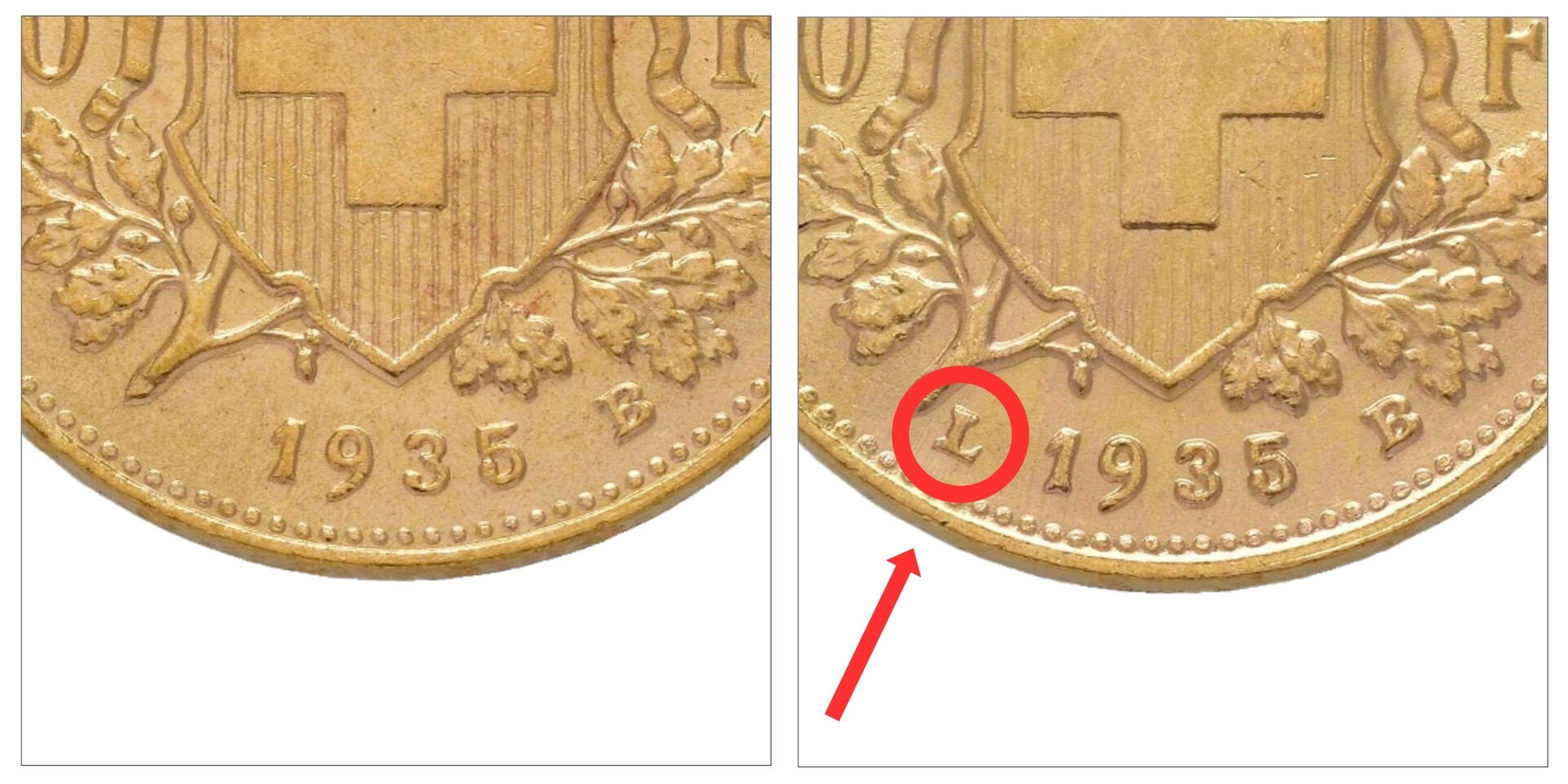
How can I tell the difference between the 1935 LB Vreneli and the 1935 B?
Two different minting varieties exist for the year 1935:
1935 LB: With a large L (for Lingot) to the left of the date and a large B (mint mark for Bern) to the right of the date. With a mintage of over 20 million pieces struck, this is the most common Vreneli.
1935 B : With a large B (mint mark for Bern) to the right of the date and without an L on the left side of the date. The mintage of this variety is 175,000 pieces.
You can find exact mintage figures and the respective prices here.
How can I recognize a Vreneli made from Gondo gold?
In 1897, 20-franc gold Vreneli coins were struck from so-called Gondo gold – the gold comes from the Valais village of Gondo. Only 29 specimens of this pattern were struck.
The Gondo gold Vreneli can be recognized by the additional cross struck into the Swiss cross, as well as by its Brilliant Uncirculated quality.
The two HELVETIA gold coins from 1893 and 1895 were also struck from Gondo gold, likewise with an impressed cross in the Swiss cross.
You can find further rare pattern strikings of Swiss gold coins here.
How can I recognize the 1897 Vreneli with forelock?
This pattern was struck in a very small mintage of only 12 pieces. It can be recognized by the forelock, which is absent from the regular issue.
You can find further rare pattern strikings of Swiss gold coins here.
Why are some current Swiss federal coins not available for delivery?
The Swiss National Bank (SNB) puts the new coins into circulation. New dates are only released into circulation once the minted quantities have been fully issued. In individual cases, this means that current dates only enter circulation years later.
For this reason, some current dates are marked as "not available", because, as described, they have not yet been issued at all.
How can I identify the year dates on Swiss banknotes?
1st to 5th series: date and year printed on the obverse.
From the 6th series onwards: the first two digits in the serial number correspond to the year.
Example 76K01234567 - corresponds to the year (19)76
What is the significance of the signatures on Swiss banknotes?
Swiss banknotes bear the signatures of the respective members of the Governing Board. Thus, all notes feature three different signatures.
You can enlarge these signatures by clicking on the two corresponding capital letters.
How do I order from www.schweizergeld.ch?
Most coins can be ordered in various grades.
For the coin you want, click on the desired grade for the year date - this will place the item in your shopping cart.
If you would like several specimens of one item, you can either click the item several times or increase the quantity directly in the shopping cart.
Once all the desired items are in your shopping cart, you can complete the ordering process:
Click on the shopping cart and enter the required details, agree to the terms and conditions, and submit.
If the transmission is successful, you will immediately receive an order confirmation by e-mail.
Can I collect my order at Neuengasse 38 in Bern?
Yes, you can also collect your products from our shop and pay in cash or by card. To do so, please tick the box «Goods will be collected from the shop at Neuengasse 38 in Bern» when ordering. This means there are no packaging or postage costs.
As soon as we have put together the ordered items for you, we will inform you by e-mail that they are ready for collection. You can then collect your order during our opening hours.
Would you like to inspect a specific coin before purchasing it? We are also happy to send the desired coins to customers known to us for non-binding inspection. If you are a new customer, you can pre-order the coin as usual, tick «Collection in store» and inspect the coin during your visit – completely free of charge and without obligation.
What should I do in the event of an incorrect delivery?
If a delivery is incorrect, please send us a brief notification by e-mail. We will resolve the matter straightforwardly and will of course cover any shipping costs for returns.
Return address:
Johannes Müller & Söhne AG
Neuengasse 38
Postfach 9549
3001 Bern
What does “not available” mean?
Items highlighted in red or items marked “on request” are currently not available. You can nevertheless order them in the sense of a want list: as soon as the item is back in stock, we will contact you.
Such a want list is free of charge for you and without any obligation to purchase.
I have not received an order confirmation – what now?
Every order automatically triggers an order confirmation by e-mail. If you do not receive one, your order was not transmitted.
Do you also ship abroad?
Yes.
Exceptions: gold coins as gold investments and accessory items.
Please note that, depending on the country, customs duties or VAT may apply. These are not included in our sales prices and must be borne by the buyer. Thank you for your understanding.
Where can I store my collectibles, precious metals and other tangible assets?
For the storage of collectibles, precious metals such as gold or silver, and other tangible assets, three different options are generally available to you: keeping them at home, in a bank safe deposit box, or with a private storage company. Each solution offers advantages and disadvantages.
Storage at home
Home storage in a hiding place or safe has the advantage that your assets are accessible at any time without incurring ongoing costs. However, the risk of burglary and theft is high. Under a standard household contents insurance policy, the loss of precious metals or other valuables is covered only up to a low maximum limit.Bank safe deposit box
Alternatively, you can open a safe deposit box at your bank. The level of security is significantly better than with home storage. However, the physical security concepts depend on how modern the building is. Taking out safe deposit box insurance is strongly recommended depending on the value deposited, but is often not possible or only possible with restrictions.Private storage company
A safe deposit box with a private storage company, such as Swiss Gold Safe in Switzerland or Swiss Gold Safe in Liechtenstein, enables bank-independent safekeeping of precious metals and other tangible assets. The contents can be fully insured.
The high-security vaults of Swiss Gold Safe AG are also suitable for segregated storage of gold or VAT-free silver, platinum and palladium in a bonded warehouse.Investment precious metals such as bars and coins made of gold and silver can likewise be stored independently of banks in segregated storage with OrSuisse AG. In addition to high-security storage in a domestic or bonded warehouse, OrSuisse AG issues transferable warehouse receipts. Full insurance is included.
Was your question not answered?
If you cannot find the information you are looking for, you are welcome to send us your enquiry via the contact form.